How it works
Skenai draws the drum & bass scene from what artists publish. Nothing is typed in by hand except the corrections you send: the map is rebuilt every night.
The search
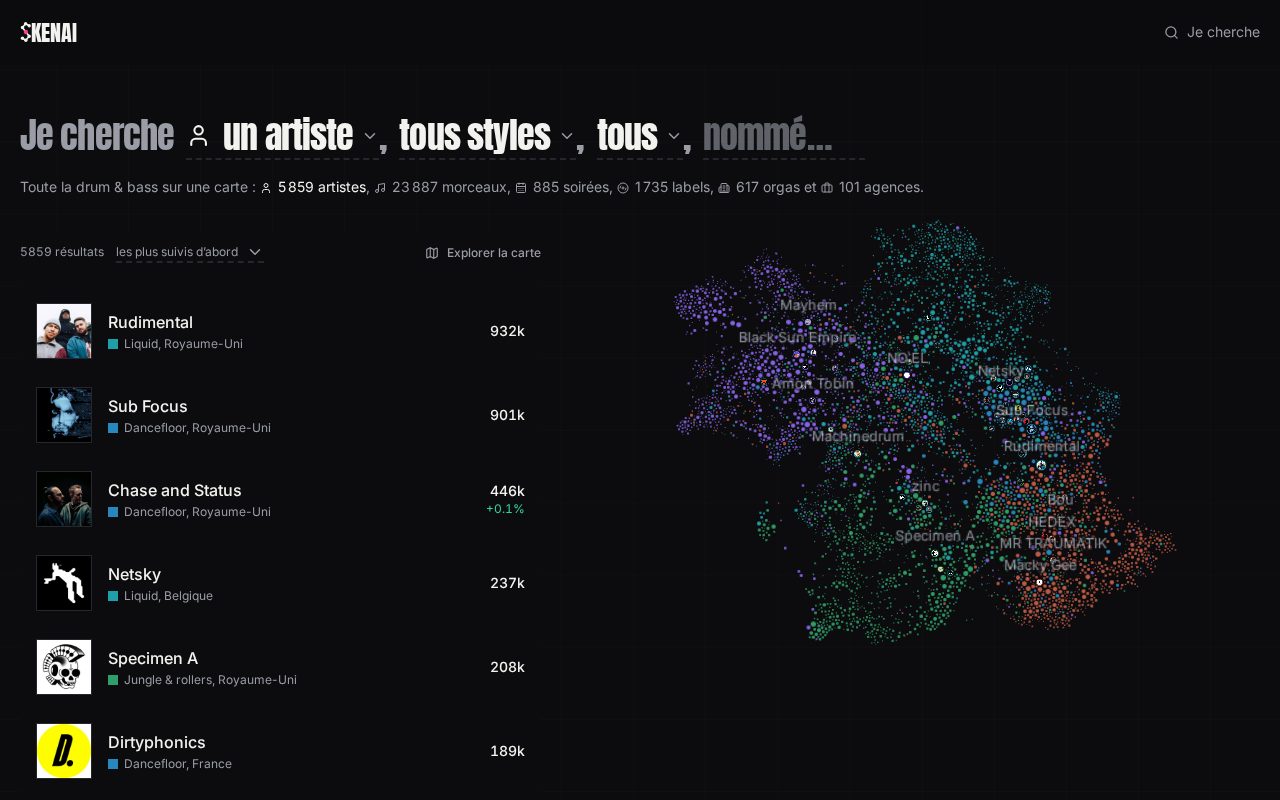
The home page is a sentence to complete: I’m looking for an artist, a night, a label, a track, a promoter or an agency, then where, when, which style, and in what order. The list below answers, and the map behind lights only what the list shows. Hover a row: the map glides to it.
A row’s play button starts its track, and the list becomes the player’s queue: the end of a track moves on to the next. The player follows you from page to page.
The map
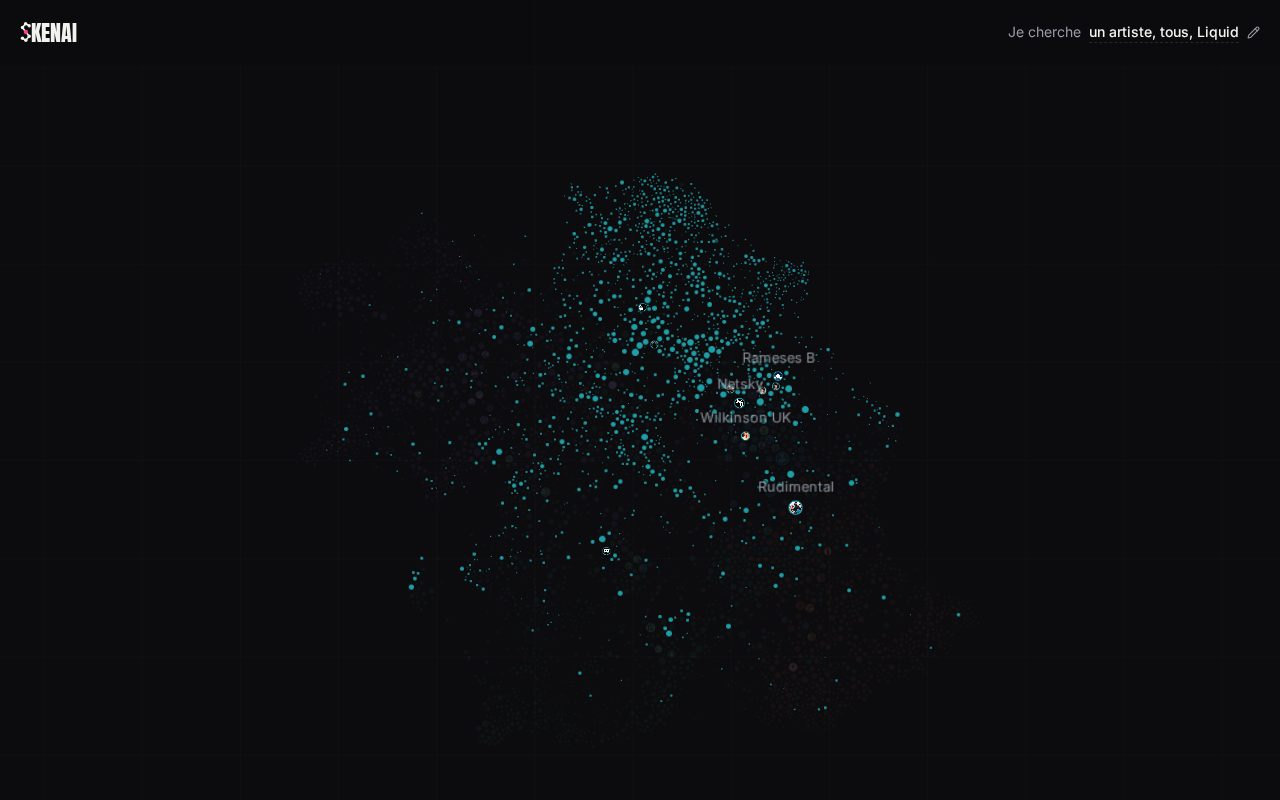
A click on the map opens it full size, with the same sentence: what it points to lights up, and it stays written at the top, a click on it takes you back to the search. Each disc is an artist. Its size is their followers; its colour, their style. Point at a disc: its collaborations light up. Click: their page opens.
Scroll to zoom, drag to move, 0 to see everything. On a phone, pinch and drag. The styles and the filters sort what is shown, and disc size can follow the hype instead of followers.
The pages
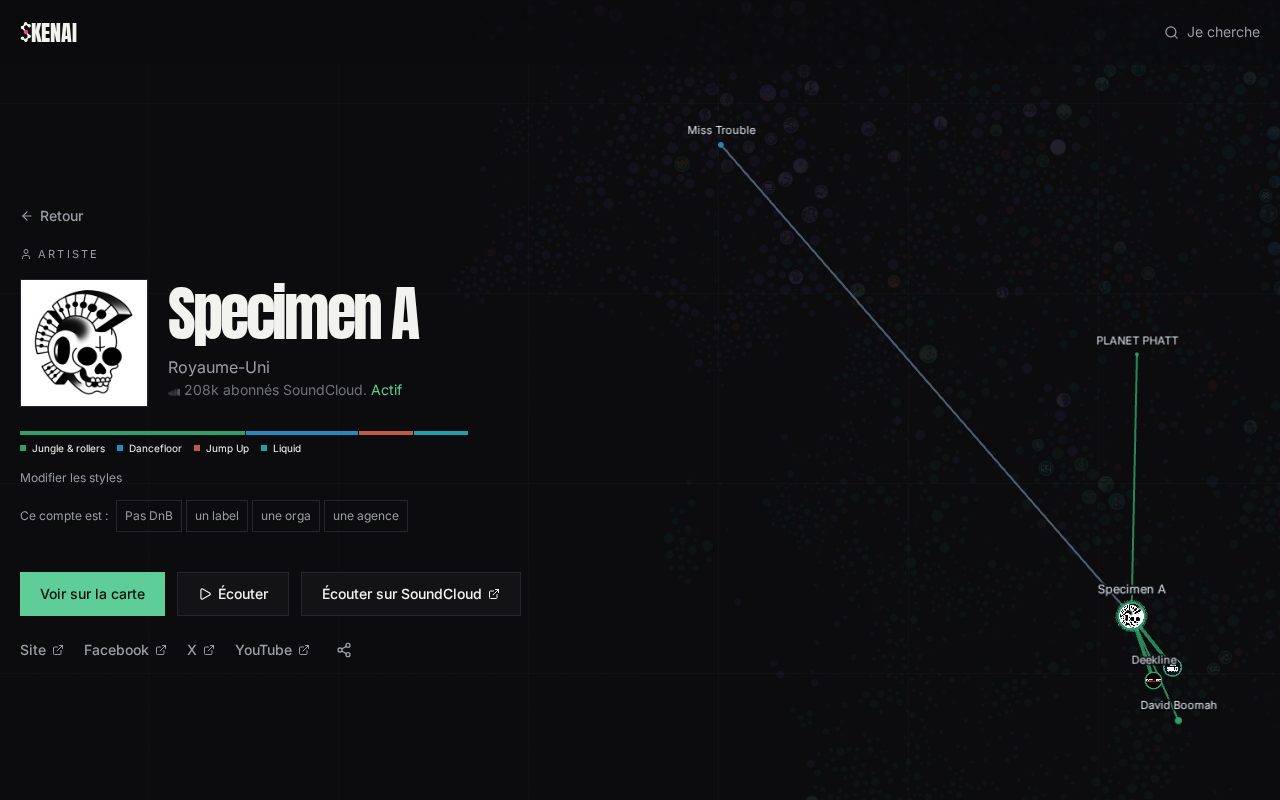
Every artist, night, promoter, label and agency has a page: the map framed on it, then what we know. For an artist: their tracks, who they work with, what they release, who books them, where they play. Their page and the player take the colour of their style. On a night, a label, a promoter or an agency, “See on the map” lights its lineup or roster.
A promoter is whatever is credited as organiser of at least one night and has booked at least three artists of the map in the nights we know of, on Resident Advisor as on Shotgun. A club that programmes its own nights is one; the venue of a night lives on the event page, with its address and photo, and leads to its promoter page when it has one.
An artist page also carries their hype, out of 100: five percentiles among the artists on the map (follower growth over seven days, upcoming dates, plays, wider audience, followers). And “Is this you?”: an artist or their agent claims their page with a code placed in their SoundCloud bio; the nightly pass verifies it, and the page then says who is speaking and the declared contact. The email of the request is never shown.
The trend
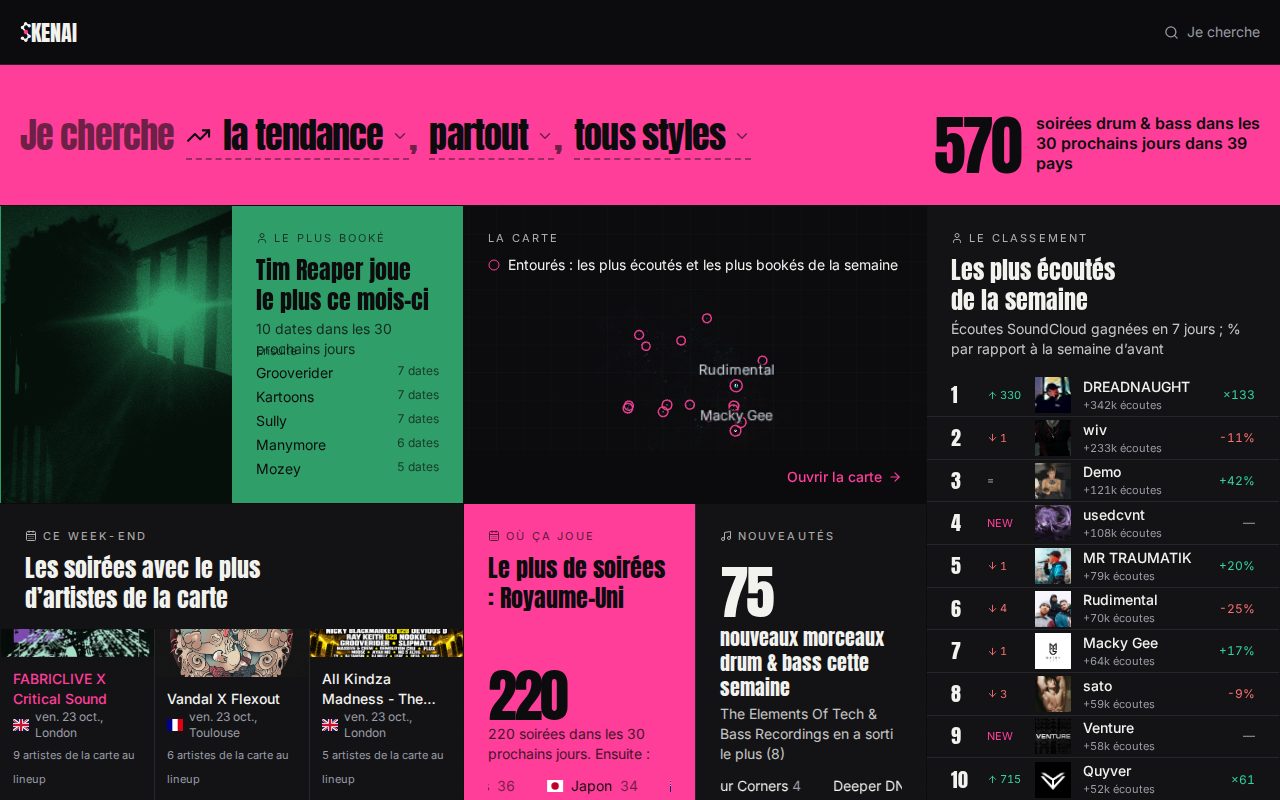
“I’m looking for the trend” turns the page into the week’s wall: the most played tracks, the most booked artists, where it plays, the new releases and the weekend’s nights, by country and style. A rise is written in green, a fall in red.
Your night is missing from the nights? The form under their list gets it in the next day.
Where the data comes from
SoundCloud for artists, their tracks and who follows whom. Discogs and Beatport for releases, credits and labels, Discogs also for a label’s presentation, logo and site. Resident Advisor and Shotgun for events (lineup, price, capacity), organisations (logo, presentation) and booking contacts. MusicBrainz and Wikidata for a label’s founding and history, Mixcloud for sets, OpenStreetMap to place venues. Last.fm for tags, Deezer and YouTube for the wider public.
Every answer is kept as is, dated, before being read: what gets old is re-read without losing what we knew, and any computation can be replayed.
Who gets on the map
An artist gets in if they can be found on SoundCloud, have an audience, and at least one proof of their own says they belong to the scene: their own SoundCloud tags, their Last.fm tags, a release on a label of the map, the drum & bass share of their Beatport catalogue, or the curated starting library (a playlist or a lineup is not enough). An announced night makes them a priority, it exempts them from nothing: they pass the same tests as everyone. No proof, no entry, whatever the neighbours say.
They leave if their own tracks tell another world (hardstyle, house, hip-hop...), if the account is a label or a medium posting a hundred artists’ tracks, or if the name resolved to a namesake. A “not DnB” click on the site removes them the next night; a correction sent from the site is never overwritten by the computation.
The style comes from their own signals when they have some (tags, labels with a clear editorial line); otherwise it is inferred from collaborators. The “Jungle & rollers” pole holds both: too few artists tag “roller” to make a pole of its own.
What a link is
A line between two artists is proof: a track with two names, a credit on a release, a remix. Never a resemblance or a mere follow.
How the map is drawn
Each artist sits next to those they share the most with: labels, follows, listeners, collaborations, cities. The map starts from yesterday’s so it does not move from one night to the next, then the discs spread out so they do not overlap. Islands are named after their dominant style and three most followed artists.
The style comes from the artist when they state it. Otherwise it comes from their neighbours, and the page says so.
The night
0. All day long: emptying the pool
- Every fifteen minutes, outside the publishing window: snowball (300 accounts followed by at least 20 known accounts), scene-proven candidates (up to 2,000 per cycle: announced nights, RA lineups, label rosters, Beatport credits, Discogs releases, label account titles).
- SoundCloud resolution of new names, followings, profile, tracks (duration kept: over 5 minutes is a set), Last.fm tags and similar artists, city and places turned into countries.
- Collection steps aside as soon as publishing is waiting, even in the middle of a step.
1. Re-reading what exists
- First, what the night needs: tools, browsers, libraries, secrets, disk space. Anything missing is named at midnight.
- The sources are re-read at the same time, one per server and each at its own pace: SoundCloud, Last.fm, geography, Resident Advisor, Deezer, YouTube, then Shotgun and Beatport in Chromium. The night lasts as long as the longest one instead of their sum.
- Every account on the map re-read: followers, tracks, city, avatar, bio (public links every 90 days); 300 followings caches older than 30 days; the 300 oldest Last.fm entries and the 1,000 oldest geography ones.
- Resident Advisor: drum & bass nights of 639 areas (201 countries), genre-free scans of the 25 busiest areas, RA pages of the map’s artists (biography, aliases, articles, the whole date history), 100 unmatched retried, new promoters and RA labels plus 100 re-read, 300 venues re-read every 90 days, 60 unknown promoters named by our histories.
- Deezer (fans, 300 re-read); on Mondays, Discogs: drum & bass and jungle releases of this year and last, added to what we had (collaborations, artists’ labels). YouTube: subscribers and views of 400 artists through the API, the most recent filmed set of 1,200 artists, and sets found from the PC.
- Shotgun in Chromium: artist sitemaps on Mondays, matched artist pages, 150 night sitemap pages, city listings (239 areas), promoters; a Shotgun pass that fails is retried once, after the re-reads, when memory is free again. Beatport: tracks, roles and labels of 300 artists, credit edges; a blocked artist keeps what we knew, and many blocks are reported as a failure.
2. Analysis and the gate
- Claimed pages (the token placed in the SoundCloud bio), site corrections (“not DnB”, styles), curation, analysis: six scene-membership proofs per artist; a night alone is not enough, an artist needs a proof of their own. Styles, label accounts removed, homonyms, places.
- If the analysis fails, the night stops and alerts: yesterday’s map stays served, with its date.
- Placement: every artist next to those they share relations with (labels, follows, listeners, collaborations, cities), aligned on yesterday’s map, without overlaps; islands named after their dominant style and three most followed artists, plus a country when it clearly weighs.
- Resting: an account rejected three nights in a row, with no drum & bass signal at all and few followers on the map, is no longer re-read on Last.fm; it is still examined every night and wakes up at the first signal, or after 90 days.
- Preview start points, dataset, the day’s series, hype out of 100 (growth, dates, plays, wider audience, followers).
- The new graph replaces the old one only if it passes verification (anchors, greys, intruders, size between 0.9 and 1.5 times yesterday, and no source lost: no more than 3% of artists deprived of a proof or a piece of data they had yesterday). Otherwise yesterday stays, nothing below is rebuilt, and the refusal is sent as an alert.
3. What is served (if the map passes)
- Agenda, RA pages (the queue of possible homonyms is reported at ten pages), agencies (booking emails, agency site), promoter and label videos and Mixcloud sets, promoter pages, labels (Deezer, Discogs 200 a night, MusicBrainz 200, Wikidata and Wikipedia 100), dated releases, the map image for the home page.
- Check of the announced-night rule: how many announced artists are still missing, and why.
- The real site, public and dev: a sample of every page type read back, the served map compared with the one on disk, and the map opened in a browser (it draws, without errors, and a search leads to the page).
4. Memory and checks
- Store, the day’s series, 7-day rising radar; on Sundays the database gives back the space of purged rows.
- Freshness of every source, contract tests of what is served and of the rules (failures named), backup to the Drive.
- Every failed step is written to the log with its last error lines, and the closing summary is sent as an alert.
Sequence current as of 2026-10-15, starts at midnight UTC, map published in the morning
Collecting new names runs all day long. At midnight UTC, everything is rebuilt in the order below: re-reading, sorting, analysis, drawing, publishing, checking; the map comes out in the morning. The new one only replaces the old one if it passes the gate: no hole, no explosion.
One rule holds it together: an announced night imposes its artists. They are proposed without a cap, and every morning a check says how many are still missing, and why.
Every night also keeps everyone’s follower count. That is how we can say who is rising.
What is still missing
Artists without SoundCloud. Events neither Resident Advisor nor Shotgun announce. The style of those who never stated it. Spotted an error? Every page has a button to report it.